
Natural Intelligence
R&D 2025-2026
Practice-based research:
The Return to Natural Intelligence is a project inspired by ancestral artistic practices,
consciously developed with knowledge of their ecological, social, and material impact.
What does the piece consist of?
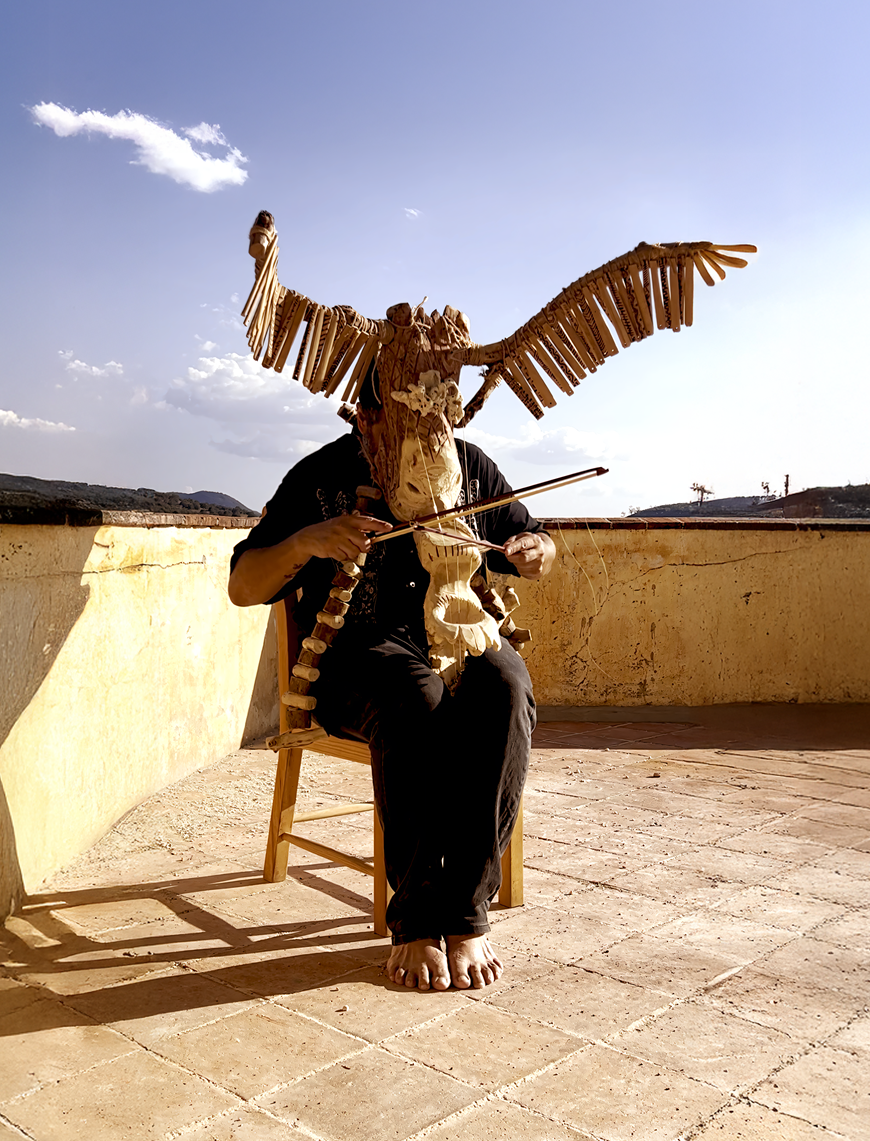
It is a habitable scalable installation activated through sonic performance, where the wearable sculpture continues
to grow and expand, becoming a living interface — until it kinetically envelops the performer in a space of deep listening
where the human body merges with musical nature.
The wearable wood mask incorporates a double wireless microphone system that amplifies the rubbing of the strings.
The touch of the wood carved with abstract symbols resembles a cave musical score, and the kinetic elements of the
mask themselves as they resonate with each other and through the body of the performer—once an individual,
now finally immersed in a holistic state of animistic nature.
Footage excerpts
from Kanazawa International Experimental Music Festival
2026, 第3回 金沢国際実験音楽祭
Live Performance, March 6, 2026, by Julian Bonequi
(wearable art, mapped drums, electroacoustic handmade instruments, and vocals).
Drone videography by Marco Vidali, recorded at Tierra Nueva Project, in Telpintla, municipality of Temascaltepec, Mexico.
“Project supported by the System of Support for Creation and Cultural Projects.”
The wearable instrument and mask, is part of a series of work-in-progress transcendental reunification amplifiers, seeking to restore connection with nature and honor the animistic traditions through ritual channeling technologies, habitable sound and regenerative sustainable practices at a planetary scale.
Developed in the mountains of Telpintla, Mexico, this project recognizes the human body as sophisticated wetware, capable of channeling unconventional sonic rituals composed of organic and symbiotic systems. Within this evolving practice, habitable sound functions as a primal natural-intelligence interface, where the body amplifies the necessity of reconnecting with the spirit of nature through sustainable artistic creation.
For this, I gathered wood in the
mountains of Amatlán de Quetzalcóatl, municipality of Tepoztlán, Mexico, and carved into a wearable electroacoustic
mask combining plum tree and ocote wood with natural acoustic amplification as an ritual-harmonic multiplier.
As both mask and instrument, it draws inspiration from the world’s oldest sustainable ritual art practices and planetary technologies:
NATURAL INTELLIGENCE
Making of
October 2025- March 2026
Premiered in Kanazawa on March 8, 2026, the work marks a turning point. After years developing large-scale XR interfaces, I began questioning the direction of technological art and technological society itself. Technological sophistication without ethical coherence risks perpetuating disembodiment — even in art.
Since 2020, I have reconsidered the logic of technological production, which often prioritizes immediacy and automation over the living processes necessary for human and ecological wellbeing.
Perhaps it is time to move toward an art that listens to the living voice shared by nature, working in reciprocal collaboration with biodiversity. At the same time, global models of art production continue to reproduce political and cultural agendas shaped by colonial structures, because colonialism never ended.
When the artwork becomes detached from the body , from matter, and from the hands that make it, art risks becoming an abstract idea executed against the intelligence of those who cultivate the materials, the territories, and the ecosystems that sustain life.
This project is a life manifest. A celebration of Natural Intelligence, and an invitation to relearn how to create in ways that are physically, mentally, and ecologically necessary — returning soul and health to the act of living creatively.
Previous version, December 13, 2025, at CaSa
Centro de las Artes de San Agustín, Etla, Oaxaca.
Plum tree trunk and ocote collected in the mountains of Amatlán de Quetzalcóatl.
Concept, sound design, and wood carving by Julian Bonequi.
All branches were collected from nature without cutting any material from the trees.